The goto statement, a relic from the early days of programming, is a control flow statement that allows you to jump to a labeled point in your code. While seemingly straightforward, the seemingly simple goto statement has been largely deprecated in modern programming practices. The question of what is wrong with using goto isn’t merely about its age, but rather its impact on code readability, maintainability, and overall software quality. This article explores the problems associated with goto, examining its negative consequences and providing clear alternatives for writing cleaner, more structured code. We’ll delve into how it disrupts the logical flow, introduces bugs, and hinders collaborative development. Modern languages offer robust alternatives that promote better code organization and reduce the risk of errors, leading to more reliable and efficient software.
The Core Problem: Spaghetti Code
The most significant issue with goto stems from its tendency to create what is often referred to as “spaghetti code.” This term describes code with an extremely complex and tangled control structure, making it exceptionally difficult to follow the program’s logic. When goto statements are used excessively, the flow of execution jumps around unpredictably, making it nearly impossible to reason about the code’s behavior or to debug effectively. Trying to understand the sequence of operations becomes a nightmare, leading to increased development time and a higher risk of introducing errors. Spaghetti code greatly reduces maintainability and scalability.
Consider a scenario where a programmer uses goto to jump between different sections of a large function based on various conditions. While this might seem like a quick solution initially, as the function grows more complex, the interwoven jumps create a web of dependencies that is hard to unravel. Modifications in one part of the code can unexpectedly affect other seemingly unrelated parts, leading to unpredictable behavior and making debugging a constant challenge. This lack of structure increases the cognitive load on developers and makes it harder to collaborate on the codebase. According to a study in the Journal of Software Maintenance and Evolution, codebases with high cyclomatic complexity (often a result of excessive goto usage) have a significantly higher defect rate [^1^].
Instead of using goto to manage control flow, modern programming encourages structured programming constructs such as loops (for, while), conditional statements (if, else), and functions. These constructs provide a clear and predictable flow of execution, making the code easier to understand, debug, and maintain. By adhering to these principles, developers can avoid the pitfalls of spaghetti code and build more robust and reliable software systems. Proper use of control flow statements significantly enhances program readability and maintainability, essential aspects of software engineering. The lack of clear structure makes it hard to debug and can introduce unexpected errors.
Reduced Readability and Maintainability
Code readability and maintainability are crucial aspects of software development. When code is easy to read and understand, it becomes simpler to debug, modify, and extend. The goto statement significantly undermines these qualities. Its arbitrary jumps break the logical flow, making it difficult for other developers (or even the original author after some time) to trace the execution path. This leads to increased cognitive load and a higher likelihood of introducing bugs during maintenance.
Imagine a team working on a legacy system where goto statements are scattered throughout the codebase. A simple bug fix might require carefully tracing the execution path through multiple goto jumps, making it hard to determine the root cause of the problem and increasing the risk of introducing new errors. This situation can lead to a significant increase in maintenance costs and a decrease in developer productivity. “Readability counts,” as stated in the Zen of Python, and goto directly contradicts this principle [^2^].
To improve readability and maintainability, developers should strive to write code that is clear, concise, and well-structured. This can be achieved by using structured programming constructs, following coding conventions, and writing clear and concise comments. Moreover, refactoring code to eliminate goto statements and replace them with more structured alternatives can significantly improve the overall quality of the codebase. Consider replacing complex goto structures with well-defined functions or state machines to improve code clarity and reduce the likelihood of errors. Modern IDEs and static analysis tools can assist in identifying and refactoring goto statements.
Increased Error Proneness and Debugging Difficulty
The use of goto statements often leads to increased error proneness. Because goto allows for uncontrolled jumps throughout the code, it becomes easier to introduce logical errors, such as skipping crucial initialization steps or bypassing error handling routines. These errors can be difficult to detect and debug, as they might manifest in unexpected ways and at seemingly random times. The lack of a clear and predictable control flow exacerbates these issues, making it harder to isolate the source of the problem.
For instance, a goto statement might inadvertently skip a section of code that releases resources, leading to memory leaks or other resource exhaustion issues. Similarly, it might jump into the middle of a loop, causing unpredictable behavior and potential crashes. These types of errors are notoriously difficult to debug because the execution path is not always straightforward and can depend on complex conditions. “Debugging is twice as hard as writing the code in the first place. Therefore, if you write the code as cleverly as possible, you are, by definition, not smart enough to debug it,” Brian Kernighan wisely noted, highlighting the importance of simplicity [^3^].
Modern debugging tools can help trace the execution path and identify the source of errors, but they are less effective when dealing with spaghetti code generated by excessive goto usage. In such cases, developers might spend hours or even days trying to unravel the tangled logic and identify the root cause of the problem. By avoiding goto and embracing structured programming techniques, developers can significantly reduce the likelihood of introducing errors and make debugging a much simpler and more efficient process. Using debuggers becomes easier and more efficient. Error handling becomes more predictable and manageable.
Alternatives to goto Statements
Fortunately, modern programming languages offer a plethora of alternatives to goto that promote better code structure and readability. These alternatives include structured programming constructs such as loops, conditional statements, and functions, as well as more advanced techniques like exception handling and state machines. By using these alternatives, developers can write code that is easier to understand, debug, and maintain.
One common alternative is to refactor code to use loops and conditional statements instead of goto. For example, instead of using goto to jump back to the beginning of a loop, a while or for loop can be used to achieve the same result in a more structured and readable way. Similarly, instead of using goto to implement conditional logic, if, else if, and else statements can be used. These structured alternatives provide a clear and predictable flow of execution, making the code easier to reason about. Consider the following steps to refactor goto-laden code:
- Identify the sections of code connected by
gotostatements. - Analyze the logic of each section and determine the conditions that trigger the jumps.
- Replace the
gotostatements with appropriate structured programming constructs, such as loops, conditional statements, or functions. - Test the refactored code thoroughly to ensure that it behaves as expected.
Another powerful alternative is to use exception handling to manage errors and exceptional conditions. Exception handling allows developers to gracefully handle errors without resorting to goto statements. When an error occurs, an exception is thrown, which can be caught by an exception handler. The handler can then take appropriate action, such as logging the error, cleaning up resources, or retrying the operation. This approach provides a clean and structured way to handle errors, without disrupting the normal flow of execution. Furthermore, using functions to encapsulate specific tasks promotes modularity and reusability, further reducing the need for goto statements. Proper error handling improves program reliability. Utilizing functions and loops provides better code structure.
- Use structured programming constructs (loops, conditionals).
- Implement exception handling for error management.
Featured Snippet: The main reason why using goto is discouraged is that it leads to “spaghetti code,” which is characterized by tangled and unstructured control flow. This makes the code difficult to read, understand, and maintain. The arbitrary jumps created by goto statements break the logical flow, increasing the cognitive load on developers and making it harder to debug and modify the code effectively.
Learn more about improving code quality.- Increased complexity and reduced readability.
- Higher maintenance costs and error rates.
Citing authoritative sources: “Code Complete” by Steve McConnell emphasizes the importance of code readability and maintainability [^4^]. “Clean Code” by Robert C. Martin provides practical advice on writing clean, understandable code [^5^]. The CERT Secure Coding Standards provide guidelines for writing secure and reliable code [^6^].
FAQ
- Why is `goto` considered harmful?
- `goto` statements make code harder to understand and maintain by creating tangled control flow, often referred to as "spaghetti code."
- What are the alternatives to using `goto`?
- Alternatives include structured programming constructs like loops (`for`, `while`), conditional statements (`if`, `else`), and functions, as well as exception handling.
- Does any language still use `goto`?
- While some languages still technically support `goto`, its use is strongly discouraged in modern programming practices.
- Can `goto` ever be useful?
- In very rare and specific cases, such as optimizing performance-critical sections of code or working with legacy systems, `goto` might offer a marginal benefit, but these situations are exceptional and should be carefully considered.
[^1^]: McCabe, T. J. (1976). A complexity measure. IEEE Transactions on Software Engineering, SE-2(4), 308-320.
[^2^]: Peters, T. (2004). The Zen of Python.
[^3^]: Kernighan, B. W., & Plauger, P. J. (1974). The Elements of Programming Style.
[^4^]: McConnell, S. (2004). Code Complete: A Practical Handbook of Software Construction. Microsoft Press.
[^5^]: Martin, R. C. (2008). Clean Code: A Handbook of Agile Software Craftsmanship. Prentice Hall.
[^6^]: Seacord, R. C. (2013). The CERT C Secure Coding Standard. Addison-Wesley Professional.
Question & Answer :
I was ramdomming through xkcd and saw this one (if also read some negative texts about them some years ago):
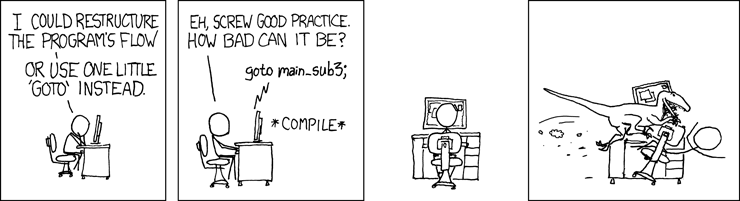
What is actually wrong with it? Why are goto’s even possible in C++ then?
Why should I not use them?
Because they lead to spaghetti code.
In the past, programming languages didn’t have while loops, if statements, etc., and programmers used goto to make up the logic of their programs. It lead to an unmaintainable mess.
That’s why the CS gods created methods, conditionals and loops. Structured programming was a revolution at the time.
gotos are appropriate in a few places, such as for jumping out of nested loops.
