IntelliJ IDEA is a powerful Integrated Development Environment (IDE) favored by developers worldwide for its robust features and efficiency. However, one common frustration developers encounter is the truncation of output during build processes. When you’re meticulously debugging or monitoring a complex build, incomplete logs can severely hinder your progress. Understanding how to stop IntelliJ truncating output when I run a build is crucial for accurate diagnosis and efficient problem-solving. This guide will walk you through various settings and configurations within IntelliJ IDEA to ensure you capture the complete output, empowering you to effectively manage your build processes and streamline your development workflow. Resolving this issue will save you time, reduce frustration, and improve the overall quality of your development experience.
Understanding Why IntelliJ IDEA Truncates Output
IntelliJ IDEA, by default, imposes limits on the amount of output displayed in the console to prevent overwhelming the system and maintain responsiveness. These limits are in place to manage memory usage, especially when dealing with very large build logs. However, this can become problematic when you need to review the entire output to identify errors, warnings, or other important information. The truncation is not a bug but a design choice aimed at balancing performance and usability. Understanding the reasoning behind this behavior is the first step in effectively addressing it. You need to configure IntelliJ to capture and display the entire build process messages.
Several factors influence how and when IntelliJ truncates output. These include the size of the output buffer, the configured console settings, and the overall system resources available to the IDE. For example, if your project generates a massive amount of logging data during the build, IntelliJ might aggressively truncate the output to prevent performance degradation. Also, certain plugins or configurations can inadvertently affect the output behavior. Knowing these contributing factors helps you fine-tune the settings to achieve the desired level of detail without sacrificing performance.
According to JetBrains, the company behind IntelliJ IDEA, “The console output is buffered to avoid performance issues when dealing with very large outputs. The default buffer size is configurable.” Learn more about running applications in IntelliJ IDEA. This highlights that understanding and adjusting the buffer size is a key aspect of resolving the truncation issue. By carefully adjusting these parameters, you can strike a balance between capturing comprehensive output and maintaining a responsive development environment.
Configuring IntelliJ IDEA to Capture Full Output
The primary solution to prevent output truncation involves adjusting the console buffer size within IntelliJ IDEA’s settings. This allows you to specify a larger buffer, ensuring that more output is captured and displayed. The larger the buffer, the more comprehensive the log you will be able to review. Keep in mind that setting the buffer size too high can potentially impact performance, especially on systems with limited resources. It’s a balancing act between complete logs and smooth operation.
To increase the console buffer size, navigate to File > Settings > Editor > General > Console (or IntelliJ IDEA > Preferences > Editor > General > Console on macOS). Here, you’ll find settings related to console buffer size. Increase the value in the “Override console cycle buffer size (kb)” field. Start by doubling the current value and testing. If truncation still occurs, gradually increase it further until you capture the entire output. Remember to restart IntelliJ IDEA after making these changes for them to take effect.
Another important setting is the “Console command history size.” While this doesn’t directly affect output truncation during builds, it does impact the history of commands you’ve executed in the console, which can be useful for debugging and troubleshooting. Increasing this value can help you retain a longer history of commands, allowing you to easily re-run commands and analyze their output without having to retype them. Experiment with different values to find the optimal balance for your workflow. This optimization is a key step in how to stop IntelliJ truncating output when I run a build.
Advanced Techniques for Managing Build Output
Beyond adjusting the console buffer size, several other advanced techniques can help manage build output and prevent truncation. One effective approach is to configure your build process to write output to a file. This ensures that all output is captured, regardless of IntelliJ IDEA’s console settings. You can then review the file using any text editor, providing a complete and unfiltered view of the build process.
To redirect build output to a file, you can modify your build scripts (e.g., Maven, Gradle) to include redirection commands. For example, in a Maven project, you can use the -l option to specify a log file. In Gradle, you can configure logging using the logging.captureStandardOutput(LogLevel.INFO) and logging.captureStandardError(LogLevel.ERROR) options. These methods ensure that all output, including errors and warnings, is captured in the specified file.
Another technique is to use external logging tools and frameworks, such as Log4j or SLF4J, to manage your application’s logging. These tools provide advanced features for configuring logging levels, output destinations, and formatting options. By integrating these tools into your project, you can gain more control over the logging process and ensure that all relevant information is captured and stored in a structured manner. This is another effective method to stop IntelliJ truncating output when I run a build. According to a study by New Relic, proper logging practices can reduce debugging time by up to 40%. Read New Relic’s Observability Maturity Model for more insights.
Troubleshooting Common Output Truncation Issues
Even after adjusting the console buffer size and implementing advanced logging techniques, you might still encounter output truncation issues. One common cause is related to specific plugins or configurations within IntelliJ IDEA that can interfere with the console output. Identifying and addressing these conflicts is crucial for ensuring complete output capture.
If you suspect a plugin is causing the issue, try disabling plugins one by one to see if the problem resolves. Start with plugins that directly interact with the console or build process. After disabling a plugin, restart IntelliJ IDEA and run a build to check if the output is no longer truncated. If you identify a problematic plugin, consider updating it to the latest version or contacting the plugin developer for support. Internal Link: Debugging Strategies
Another potential cause is related to the build process itself. Some build tools, such as Maven or Gradle, might have their own output limits or configurations that can affect the output displayed in IntelliJ IDEA. Check the build tool’s documentation for information on how to configure output settings and ensure that they are compatible with IntelliJ IDEA’s console settings. Incorrect project settings also contribute to this problem, verify all settings within your project structure.
- Check plugin compatibility.
- Examine build tool configurations.
- Why does IntelliJ IDEA truncate my build output?
- IntelliJ IDEA truncates output to prevent overwhelming the system and to maintain responsiveness, especially when dealing with very large build logs. The default buffer size is limited to manage memory usage.
- How do I increase the console buffer size in IntelliJ IDEA?
- Navigate to **File > Settings > Editor > General > Console** (or **IntelliJ IDEA > Preferences > Editor > General > Console** on macOS) and increase the value in the "Override console cycle buffer size (kb)" field.
- Will increasing the console buffer size affect performance?
- Yes, increasing the console buffer size can potentially impact performance, especially on systems with limited resources. It’s a balancing act between complete logs and smooth operation.
- Can I redirect build output to a file?
- Yes, you can modify your build scripts (e.g., Maven, Gradle) to include redirection commands, ensuring that all output is captured in a file.
- What if increasing the buffer size doesn't solve the issue?
- Consider checking for conflicting plugins, examining build tool configurations, and using external logging tools to manage your application's logging.
To stop IntelliJ truncating output when I run a build, the most effective method is to increase the console buffer size. Navigate to File > Settings > Editor > General > Console and adjust the “Override console cycle buffer size (kb)” setting. Start by doubling the current value and incrementally increase it until the entire build output is captured. This setting directly controls the amount of output IntelliJ retains and displays, preventing truncation and ensuring you have a complete log for debugging.
- Open IntelliJ IDEA Settings/Preferences.
- Navigate to Editor > General > Console.
- Increase “Override console cycle buffer size (kb)”.
- Restart IntelliJ IDEA.
- Increase Console Buffer Size.
- Redirect Output to a File.
- Utilize External Logging Tools.
Mastering how to stop IntelliJ truncating output when I run a build is a game-changer for your development workflow. By understanding the underlying causes of output truncation and implementing the techniques discussed in this guide, you can ensure that you always have access to complete and accurate build logs. This empowers you to diagnose issues more effectively, debug code more efficiently, and ultimately deliver higher-quality software.
Don’t let truncated output slow you down. Take the steps outlined here, configure your IntelliJ IDEA settings, and redirect your build output where needed. Explore related topics like advanced debugging techniques, build automation best practices, and log management strategies to further enhance your development skills. By implementing these changes, you’ll streamline your development process and ensure you never miss a crucial error message again. You can find more information on the IntelliJ IDEA website. Visit the IntelliJ IDEA official website.
Question & Answer :
When I run our build from IntelliJ it pumps out a lot of debugging.
But it gets truncated in the Run console.
Can I make IntelliJ preserve more output?
Or, preferably, all of it?
By a popular request Override console cycle buffer size setting was added to the UI 9/14/16:
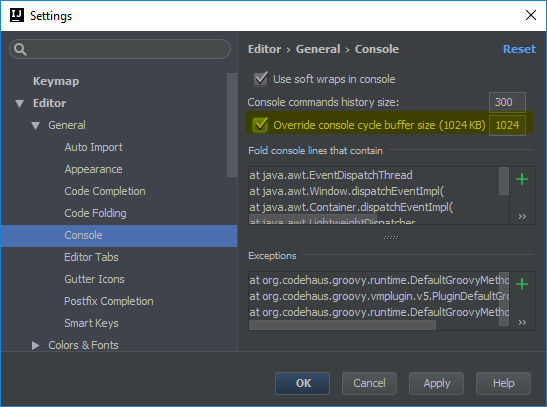
Original answer for older versions:
Edit your IDEA_HOME\bin\idea.properties file, and increase this setting:
#----------------------------------------------------------------------- # This option controls console cyclic buffer: keeps the console output size not higher than the specified buffer size (Kb). Older lines are deleted. # In order to disable cycle buffer use idea.cycle.buffer.size=disabled idea.cycle.buffer.size=1024
then restart IntelliJ.
