Choosing the right database solution is crucial for any application, and Amazon Web Services (AWS) offers a variety of options to suit different needs. Two prominent choices are Amazon SimpleDB and Amazon DynamoDB. Understanding the differences between these NoSQL database services is essential for making an informed decision that aligns with your project’s requirements. While both are designed for scalability and availability, they cater to different use cases and offer varying levels of performance, features, and pricing models. This article delves into a comprehensive comparison of Amazon SimpleDB and Amazon DynamoDB, exploring their key features, advantages, disadvantages, and ideal use cases to help you determine which service is the better fit for your specific application needs. We’ll also consider factors like data consistency, scalability, cost optimization, and the overall development experience when choosing between these two powerful AWS database solutions. Let’s navigate the complexities of NoSQL databases to make the best choice for your business.
Core Differences Between Amazon SimpleDB and Amazon DynamoDB
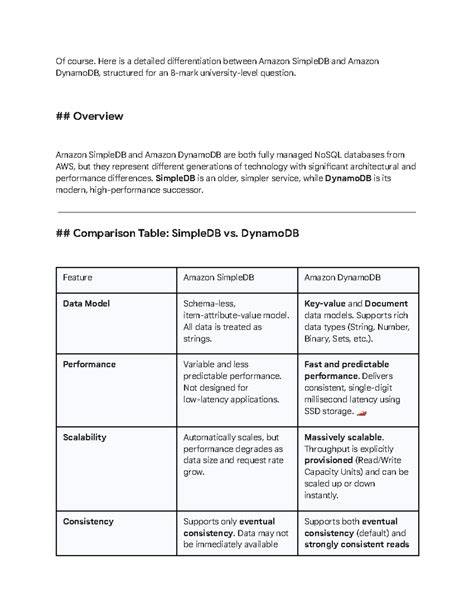
The fundamental difference lies in their architecture and capabilities. Amazon SimpleDB, one of AWS’s earliest database offerings, is a schema-less key-value store designed for smaller datasets and simpler queries. It’s essentially a highly available, fault-tolerant data store that sacrifices some performance and scalability for ease of use. Think of it as a managed database that handles much of the underlying infrastructure complexities for you.
In contrast, Amazon DynamoDB is a fully managed NoSQL database service that offers significantly greater scalability and performance. It supports both key-value and document data models and provides consistent, single-digit millisecond latency at any scale. DynamoDB is designed for high-traffic applications that demand low latency and high throughput. Its architecture is more complex than SimpleDB, but it also offers finer-grained control over performance and cost optimization.
A key distinction is how they handle data consistency. SimpleDB offers eventual consistency, meaning that updates might not be immediately visible across all replicas. DynamoDB, on the other hand, provides tunable consistency, allowing you to choose between eventual consistency for lower costs and higher throughput or strong consistency for applications that require immediate data accuracy. “DynamoDB’s ability to scale seamlessly while maintaining consistent performance is a game-changer for applications with unpredictable traffic patterns,” notes a recent AWS whitepaper [External Link 1: AWS DynamoDB Documentation].
Scalability and Performance Considerations
When it comes to scalability, Amazon DynamoDB is the clear winner. It’s engineered to handle massive amounts of data and high request volumes with ease. You can scale your database up or down as needed, and DynamoDB automatically handles the underlying infrastructure adjustments. This makes it ideal for applications that experience significant fluctuations in traffic or data volume. DynamoDB uses data partitioning and replication to achieve high availability and fault tolerance, ensuring that your application remains responsive even during peak loads.
Amazon SimpleDB, while still scalable, has limitations compared to DynamoDB. It’s designed for smaller datasets and simpler queries, and its performance can degrade as the data volume grows. While it’s suitable for applications with moderate data requirements and relatively low traffic, it’s not the best choice for high-performance, large-scale applications. SimpleDB’s scaling is also less flexible than DynamoDB’s, requiring more manual intervention and potentially leading to downtime during scaling operations.
The performance difference is also significant. DynamoDB offers consistent, single-digit millisecond latency at any scale, making it suitable for real-time applications that require fast response times. SimpleDB’s performance can vary depending on the query complexity and data volume, and it’s generally not as performant as DynamoDB for complex queries or large datasets. The speed of DynamoDB is often a key driver for choosing it over SimpleDB, especially for applications where user experience is paramount. For example, an e-commerce website using DynamoDB can quickly retrieve product information, ensuring a smooth and responsive shopping experience for customers.
Pricing Models and Cost Optimization
Understanding the pricing models of Amazon SimpleDB and Amazon DynamoDB is crucial for cost optimization. Amazon SimpleDB charges based on machine utilization, data storage, and data transfer. The pricing is relatively straightforward, making it easy to estimate costs for smaller applications with predictable usage patterns. However, the cost can increase significantly as the data volume and query complexity grow.
Amazon DynamoDB offers a more complex pricing model that includes charges for provisioned throughput (read and write capacity units), data storage, and data transfer. You can choose between on-demand capacity mode, where you pay for the actual read and write requests your application consumes, or provisioned capacity mode, where you specify the read and write capacity units your application requires. On-demand capacity mode is ideal for applications with unpredictable traffic patterns, while provisioned capacity mode is more cost-effective for applications with stable and predictable workloads.
Here’s a featured snippet-optimized paragraph: To optimize costs with DynamoDB, consider using auto scaling to automatically adjust the provisioned capacity based on your application’s traffic patterns. This ensures that you only pay for the resources you need, minimizing costs during periods of low activity. Additionally, using DynamoDB Accelerator (DAX), an in-memory cache, can significantly reduce read costs by caching frequently accessed data. Proper indexing and query optimization can also improve performance and reduce the number of read requests, further lowering costs. By carefully managing your DynamoDB capacity and leveraging its cost optimization features, you can achieve significant savings compared to SimpleDB, especially for large-scale applications.
Use Cases and Practical Examples
Amazon SimpleDB is well-suited for applications with relatively simple data models and moderate data volumes. Examples include storing user profiles for small websites, managing configuration data, or tracking inventory for small businesses. Its ease of use and simple pricing make it a good choice for developers who are new to NoSQL databases or who need a quick and easy solution for simple data storage needs.
Amazon DynamoDB, on the other hand, is ideal for high-traffic applications that require low latency and high scalability. Examples include e-commerce platforms, gaming applications, social media networks, and mobile applications. DynamoDB’s ability to handle massive amounts of data and high request volumes makes it a good choice for applications that need to scale quickly and reliably. For instance, a mobile gaming company might use DynamoDB to store player profiles, game state, and leaderboards, ensuring a seamless and responsive gaming experience for millions of players.
Consider a social media application. Amazon DynamoDB would be a more suitable choice to handle the enormous amount of user data, posts, and interactions, whereas Amazon SimpleDB might struggle with the scale and complexity. Similarly, a retail company could use DynamoDB to manage its product catalog, customer orders, and inventory levels, ensuring that its website remains responsive even during peak shopping seasons. Explore more about database solutions here.
- Amazon SimpleDB: Best for small datasets, simple queries, and ease of use.
- Amazon DynamoDB: Best for large datasets, high-performance applications, and scalability.
- Define your application’s data model and query requirements.
- Estimate the expected data volume and traffic patterns.
- Evaluate the performance requirements, including latency and throughput.
- Compare the pricing models of SimpleDB and DynamoDB based on your expected usage.
- Consider the development effort and operational complexity of each service.
- **Q: When should I choose Amazon SimpleDB over Amazon DynamoDB?**
- A: Choose SimpleDB for small datasets, simple queries, and when ease of use is paramount. It's suitable for applications with moderate data requirements and relatively low traffic.
- **Q: What are the key advantages of Amazon DynamoDB?**
- A: DynamoDB offers high scalability, low latency, and tunable consistency. It's designed for high-traffic applications that demand fast response times and can handle massive amounts of data.
- **Q: How does DynamoDB handle data consistency?**
- A: DynamoDB provides tunable consistency, allowing you to choose between eventual consistency for lower costs and higher throughput or strong consistency for applications that require immediate data accuracy. \[External Link 2: DynamoDB Consistency Models\]
- **Q: Can I migrate from Amazon SimpleDB to Amazon DynamoDB?**
- A: Yes, you can migrate from SimpleDB to DynamoDB, but it requires careful planning and execution. You'll need to export your data from SimpleDB and import it into DynamoDB, taking into account the different data models and query capabilities of each service.
- **Q: What are some cost optimization strategies for DynamoDB?**
- A: Use auto scaling to adjust provisioned capacity based on traffic patterns, leverage DynamoDB Accelerator (DAX) for caching, and optimize queries and indexing to reduce read requests. \[External Link 3: DynamoDB Cost Optimization Tips\]
Question & Answer :
I have some basic understanding what Amazon SimpleDB is, but according to the Amazon DynamoDB description it seems to be almost the same: a NoSQL Key-value store service.
Can someone simply explain the main differences between them and tell in which cases to choose one over the other.
This is addressed by the respective FAQ Q: How does Amazon DynamoDB differ from Amazon SimpleDB? Which should I use? (hash link no longer works, but use in-page Find to locate question within page) to some extent already, with the most compact summary at the end of the paragraph:
While SimpleDB has scaling limitations, it may be a good fit for smaller workloads that require query flexibility. Amazon SimpleDB automatically indexes all item attributes and thus supports query flexibility at the cost of performance and scale.
So it’s a trade off between performance/scalability and simplicity/flexibility, i.e. for simpler scenarios it might still be easier getting started with SimpleDB to avoid the complexities of architecturing your application for DynamoDB (see below for a different perspective).
The linked FAQ entry references Werner Vogel’s Amazon DynamoDB – a Fast and Scalable NoSQL Database Service Designed for Internet Scale Applications as well, which is indeed an elaborate and thus highly recommended read concerning the History of NoSQL at Amazon in general and Dynamo in particular; it contains many more insights addressing your question as well, e.g.
It became obvious that developers [even Amazon engineers] strongly preferred simplicity to fine-grained control as they voted “with their feet” and adopted cloud-based AWS solutions, like Amazon S3 and Amazon SimpleDB, over Dynamo. [addition mine]
Obviously DynamoDB has been introduced to address this and could thus be qualified as a successor of SimpleDB rather than ‘just’ amending their existing NoSQL offering:
We concluded that an ideal solution would combine the best parts of the original Dynamo design (incremental scalability, predictable high performance) with the best parts of SimpleDB (ease of administration of a cloud service, consistency, and a table-based data model that is richer than a pure key-value store).
Werner’s Summary suggests DynamoDB to be a good fit for applications of any size now accordingly:
Amazon DynamoDB is designed to maintain predictably high performance and to be highly cost efficient for workloads of any scale, from the smallest to the largest internet-scale applications.
